
Five-card poker hands: how rare each rank is out of 2,598,960 deals
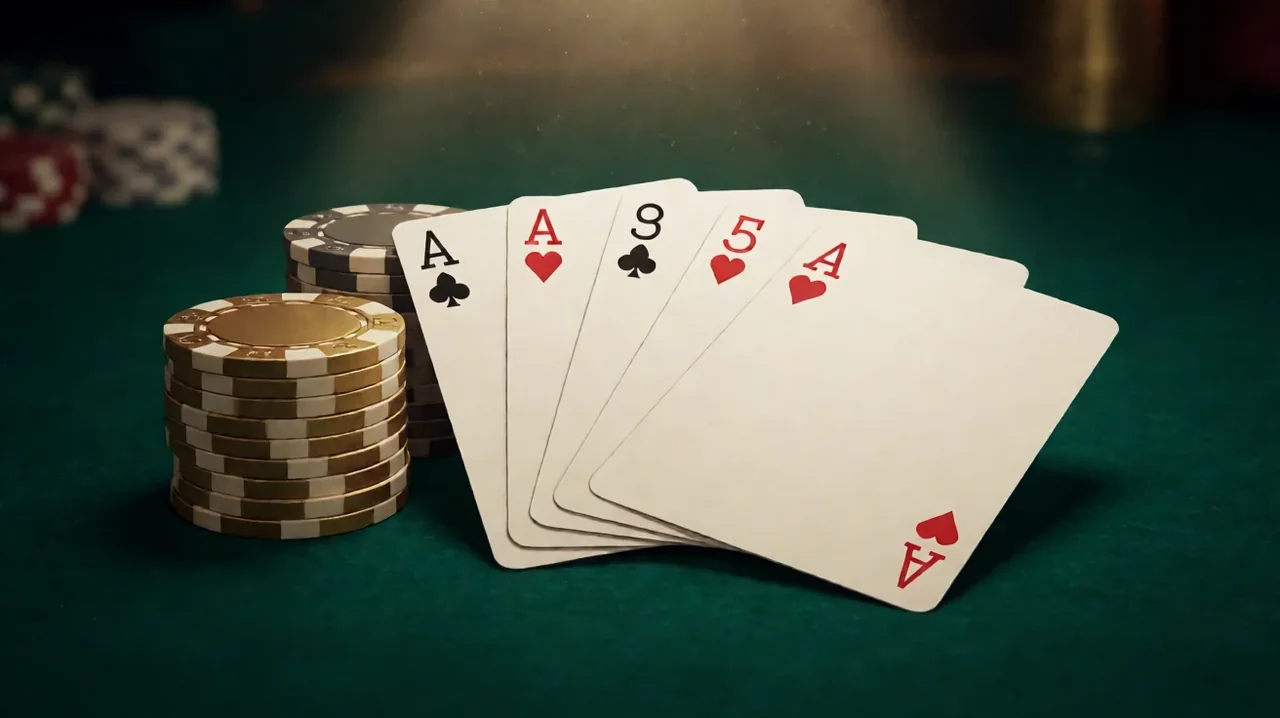
Short answer — A five-card hand is one of 2,598,960 equally likely combinations from a 52-card deck (52 choose 5). Of these, 1,098,240 hands contain exactly one pair, which makes one pair the most common made hand at about 42.26%. The rarest rank is the royal flush, with 4 hands, or about 1 in 649,740. Those numbers come from a full count of every hand, and they match the five-card frequency table published on Wikipedia (Wikipedia, Poker probability, 5-card frequencies).
This guide explains how the count works, gives every rank with its exact number of hands and its “one in N” value, and shows what those odds mean for a fair deal. Figures marked as our calculation come from our own enumeration. Sources were checked on 17 October 2026.
How the count is set up
A five-card hand is an unordered set of five cards. With 52 cards, there are C(52,5) = 2,598,960 such sets. If the deck is shuffled fairly and each deal draws five cards at random, every set is equally likely. That assumption is the basis for every probability below.
Each hand is placed in one category: the strongest one it satisfies. A hand with four cards of one rank is “four of a kind”, even though it also contains a pair. A straight flush is counted as a straight flush and not as a flush or a straight. This is why the categories add up to the total without overlap. Our check: we listed all 2,598,960 hands by computer, classified each one, and confirmed the total before reporting any figure (our calculation). The published Wikipedia table gives the same ten counts, and the category order follows the standard ranking in Wikipedia, List of poker hands.
Every rank: count, probability and one in N
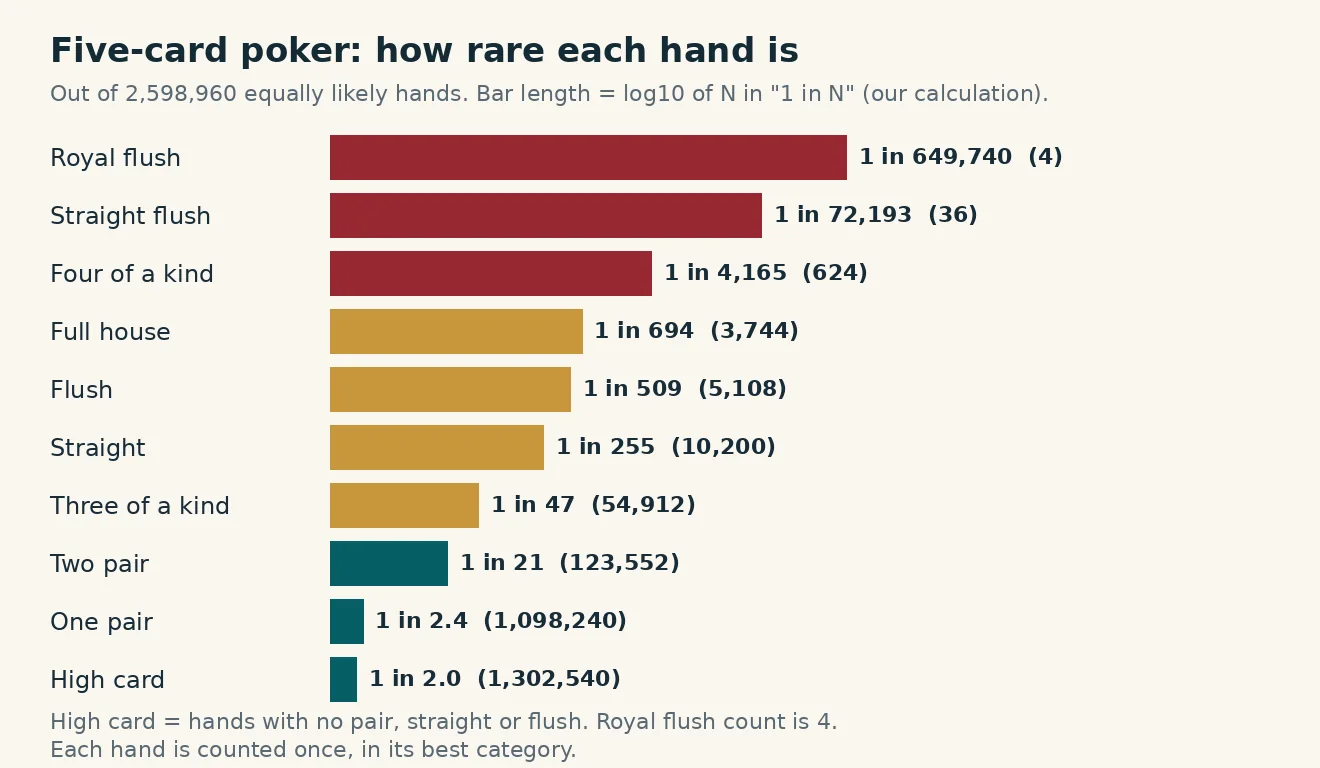
The table is ordered from the strongest hand to the weakest. The probability column is the count divided by 2,598,960, and “one in N” is the inverse, rounded to the nearest whole hand except where a decimal is needed.
| Rank | Hands | Probability (our calculation) | One in N (our calculation) |
|---|---|---|---|
| Royal flush | 4 | 0.00015% | 1 in 649,740 |
| Straight flush (not royal) | 36 | 0.00139% | 1 in 72,193 |
| Four of a kind | 624 | 0.02401% | 1 in 4,165 |
| Full house | 3,744 | 0.14406% | 1 in 694 |
| Flush (not straight flush) | 5,108 | 0.19654% | 1 in 509 |
| Straight (not flush) | 10,200 | 0.39246% | 1 in 255 |
| Three of a kind | 54,912 | 2.11285% | 1 in 47.3 |
| Two pair | 123,552 | 4.75390% | 1 in 21.0 |
| One pair | 1,098,240 | 42.25690% | 1 in 2.4 |
| High card (no pair, straight or flush) | 1,302,540 | 50.11774% | 1 in 2.0 |
| Total | 2,598,960 | 100% |
Why one pair is common and high card is the most common
Most five-card deals contain no pair at all. High card and one pair together make up about 92.4% of all hands (our calculation: 50.12% plus 42.26%). The higher categories need a specific structure: a straight needs five consecutive ranks, a flush needs five cards of one suit, and a full house needs a triple and a pair. Each condition removes most of the hands that would otherwise qualify.
Note that the high card row is the set of hands that are neither a pair, a straight nor a flush, so it is not the same as “a hand with no picture cards”. The 50% figure is a count of structures, not a claim about any particular table or game.
What one in N means in a session
A one-in-N event is not a schedule. Each fresh deal is independent, so a four of a kind could appear on the next deal or not for thousands of deals. The expected wait is N deals, and any particular stretch can be much shorter or much longer. Our calculation: at 100 deals per hour, one four of a kind is expected about every 41.7 hours (4,165 deals divided by 100 per hour).
The same logic applies to any hand. A player who sees a royal flush in a session has not beaten the odds, and a player who sees none has not been unlucky in a way that predicts the next deal. The figures describe the long run of a fair shuffle.
A break-even example for a hypothetical side bet
Suppose a hypothetical side bet on four of a kind were offered at a PHP 100 stake. The chance of winning is 624 in 2,598,960, about 0.02401%. A fair payout, one with zero expected value, would pay the stake back plus 4,164 times the stake, which is PHP 416,400 of net profit for a PHP 100 stake (our calculation: (1 − p) ÷ p = 4,164).
If the same hypothetical bet paid 1,000 to 1 instead, the expected value per PHP 100 stake would be about −PHP 75.97 (our calculation: 100,000 × 0.00024 − 100 × 0.99976). This number is for illustration only. It is not the pay table of any real game or operator, and a real side bet may pay differently or include other rules.
Limits of this calculation
The counts assume a standard 52-card deck with no jokers or wild cards, five cards per hand, and a fair random deal. Games that use wild cards, extra draws, community cards or a different number of cards have different frequencies, and the Texas Hold’em seven-card case is a separate calculation. Probabilities also say nothing about the payout, the house edge or the return to player of any game.
Our figures are calculations from a published rank structure. We have not tested any game, and the figures are not a prediction for one session. If a game shows its own hand frequencies or return to player, use the figures from that game’s information page instead.
Verified, calculated and not verified
Verified from a published reference: the total of 2,598,960 five-card hands and the ten category counts in the Wikipedia poker probability table (Wikipedia, Poker probability), and the category order in Wikipedia, List of poker hands.
Our calculation: the enumeration of every hand, the probability and one-in-N columns, the chart, the 100-deals-per-hour figure, the break-even example and the 1,000-to-1 expected-value illustration.
Not verified: the frequencies of any particular game, the pay table or house edge of any operator, and any rule variant with wild cards or community cards.
Before you play
Poker hand frequencies do not tell you how a particular table pays, and the expected loss of a bet depends on its pay table, not on how rare a hand is. Read the game’s own information before you bet, set a budget and a stopping point before you start, and treat a winning run as chance, not a pattern. Online gambling in the Philippines is for adults aged 21 and over. Use the operator’s limits and responsible-gaming tools.
Sources (checked 17 October 2026): Wikipedia — Poker probability, 5-card frequencies; Wikipedia — List of poker hands. The enumeration, probabilities, one-in-N values, chart, break-even example and expected-value figure are our own calculation.