
PAGCOR’s responsible gaming message at SiGMA Asia 2026, checked against its own exclusion and revenue data

Short answer — On 2 June 2026, PAGCOR Chairman and CEO Alejandro H. Tengco used his keynote at the SiGMA Asia Summit in Pasay City to put responsible gaming and player protection at the centre of the regulator’s message, according to PAGCOR’s own report. He pointed to the new 24/7 National Problem Gambling Helpline and cited Q1 2026 gross gaming revenue of ₱87.60 billion, down 15.87%. PAGCOR’s published data show something the speech did not mention: new player exclusions jumped from 587 in the first half of 2025 to 6,691 in the first half of 2026, about 11.4 times as many, by our calculation.
We checked every number in the speech against PAGCOR’s own industry statistics and exclusion tables, and explain what the exclusion programme is, how to use it and what the figures can and cannot tell you.
What did PAGCOR say at SiGMA Asia 2026?
According to the PAGCOR headline of 2 June 2026, Mr. Tengco told regulators, operators and technology providers that the industry must “enhance safeguards to protect players and promote responsible gaming”. Three points stood out:
- Accountability. “Innovation is matched by accountability,” he said, describing it as an obligation of regulators and industry leaders.
- The helpline. He cited the National Problem Gambling Helpline, run with the non-profit Seagulls Flock Organization, which offers counselling and referrals round the clock. PAGCOR’s launch announcement dates it to 26 May 2026 and gives the number as 02-8248-9568.
- The market cycle. He said GGR reached nearly ₱400 billion in 2025, up 6.39%, but fell in Q1 2026, with the electronic gaming segment down 22.43% “amid softer discretionary spending and broader economic pressures”.
His closing line framed the whole speech: the industry’s measure is “not simply its size or rate of expansion” but whether gaming stays regulated, responsible and beneficial to communities.
Do the speech’s numbers match PAGCOR’s tables?
PAGCOR publishes quarterly industry data on its regulatory page. We recomputed each figure from the CY 2025, Q1 2025 and Q1 2026 tables.
| Claim in the speech | PAGCOR table figures | Our check |
|---|---|---|
| 2025 GGR up 6.39% from ₱372.33B | CY 2025 total ₱396.14B | 396.14 ÷ 372.33 = +6.39% — matches |
| Q1 2026 GGR ₱87.60B, down 15.87% | Q1 2026 ₱87.60B; Q1 2025 ₱104.12B | −15.87% — matches |
| Licensed casinos ₱44.52B, 50.83% of total | ₱44.53B of ₱87.60B | 50.83% — matches |
| Electronic gaming segment down 22.43% | “Other Licensees” ₱51.43B → ₱39.90B; “Electronic Games” line ₱47.24B → ₱36.33B | Other Licensees −22.43% matches; the Electronic Games line alone fell 23.09% |
So the figures are accurate, with one nuance. The 22.43% decline matches PAGCOR’s “Other Licensees” group, which combines electronic games, bingo operations and poker. The line labelled “Electronic Games” fell slightly more, 23.09%. Neither the speech nor the tables explain the label, so we report both rather than pick one.
The Q2 2026 table, released after the summit, shows total GGR of ₱88.14 billion and Electronic Games of ₱36.25 billion. Against Q2 2025 (₱110.63 billion total, ₱59.29 billion Electronic Games) that is a 20.33% fall in total GGR and a 38.86% fall in Electronic Games, by our calculation.
How has the mix of the market shifted?
The share of Electronic Games in total GGR tells the same story more clearly than the totals. From PAGCOR’s quarterly tables, by our calculation, the line accounted for 45.37% of GGR in Q1 2025 and peaked at 53.59% in Q2 2025. It then fell to 44.38% in Q3 2025, 42.35% in Q4 2025, 41.47% in Q1 2026 and 41.13% in Q2 2026. Licensed casinos, which were steadier in pesos (₱44.53 billion in Q1 2026 and ₱45.38 billion in Q2 2026), became the larger part again, at 51.49% of Q2 2026 GGR. This is the “complementary roles” point Mr. Tengco made at SiGMA: land-based casinos held their level while online play shrank. PAGCOR’s speech attributes the decline to softer spending and economic pressure; the tables themselves do not give reasons, so we do not add any.
What does the player exclusion data show?
PAGCOR records every exclusion in its national database (the tables say records start in September 2013) and publishes the counts each quarter. The table below combines the December 2025 and June 2026 releases.
| Quarter | Self | Family | Licensee-emanating | Total new |
|---|---|---|---|---|
| Q1 2025 | 258 | 40 | 10 | 308 |
| Q2 2025 | 219 | 52 | 8 | 279 |
| Q3 2025 | 351 | 78 | 18 | 447 |
| Q4 2025 | 1,602 | 52 | 1 | 1,655 |
| Q1 2026 | 3,046 | 51 | 4 | 3,101 |
| Q2 2026 | 3,528 | 61 | 1 | 3,590 |
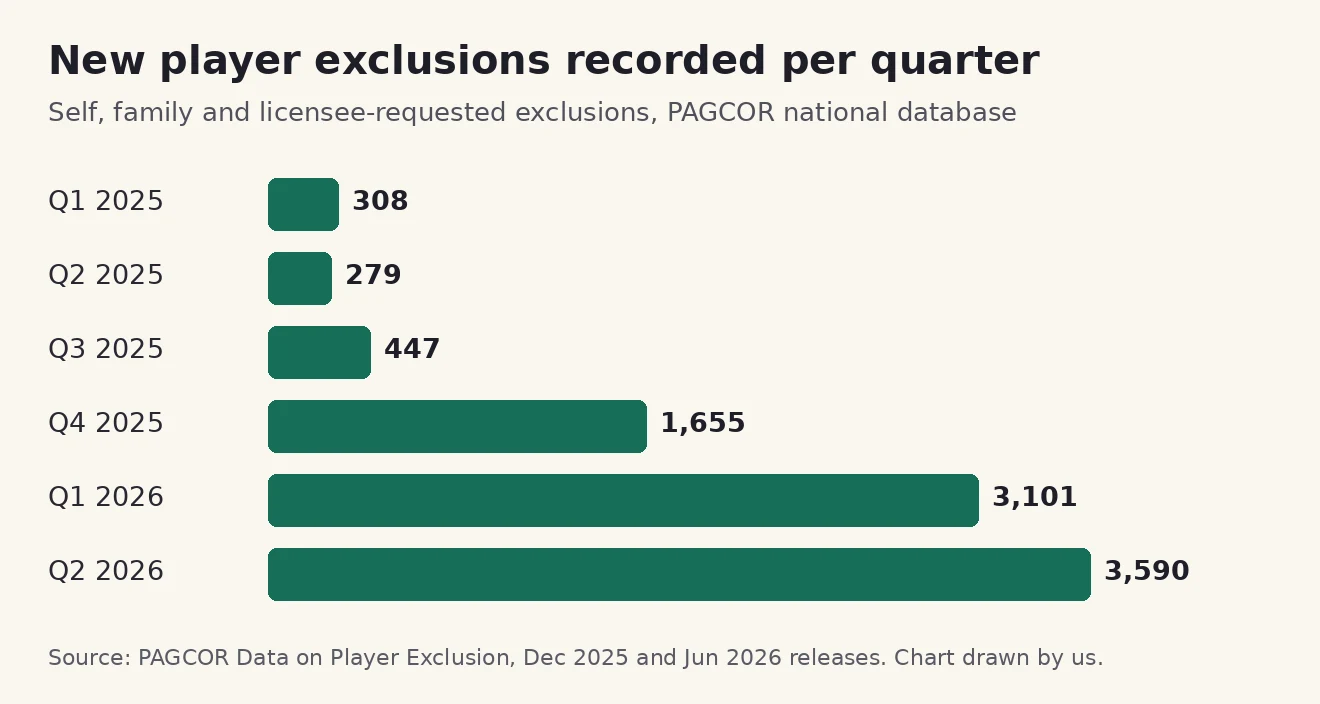
By our calculation:
- New exclusions in H1 2026 (6,691) were about 11.4 times those in H1 2025 (587).
- Self-exclusions drove almost all of it: 6,574 in H1 2026 against 477 a year earlier, about 13.8 times. Family requests barely moved (112 against 92).
- Exclusions still in force rose from 1,368 at 30 June 2025 to 9,430 at 30 June 2026, about 6.9 times.
- Since records began, 12,886 exclusions have been logged, of which 3,456 have expired.
What the data cannot tell you is why. PAGCOR’s tables give counts only, without channel, age or reason. The jump started in Q4 2025, before the helpline launched in May 2026, so the helpline cannot explain the whole increase. A rise in self-exclusion can mean more people with problems, easier access to the programme, or both; we do not have the data to separate them, and we do not claim either.
How to read the exclusion table
The categories are worth separating before drawing conclusions. “Self” means the player asked to be barred; “Family” means a spouse, child or parent applied for them; “Licensee-emanating” means the request came from a licensed operator rather than the player or family. “Expired” counts orders whose period has ended, and “Existing” is simply the running total minus the expired ones (12,886 − 3,456 = 9,430 at 30 June 2026). Because orders run for 6 months to 5 years, orders filed in Q4 2025 and Q1 2026 with 6-month or 1-year periods will reach their end dates during 2026 and 2027, and the “Existing” figure can fall even if new requests stay high. Comparing new requests per quarter, as in our chart, is therefore the cleaner way to see the trend. One more limit: the table does not say whether it counts people or orders, so a person who renews may or may not be counted twice.
How does PAGCOR’s exclusion programme work?
PAGCOR’s exclusion page describes two programmes:
- Self exclusion: for a player who feels a problem developing. Periods of 6 months, 1 year or 5 years; the first six months cannot be revoked; the order lifts automatically at the end.
- Family exclusion: a spouse, child or parent can apply for a relative, for 6 months, 1 year or 3 years, with proof of relationship.
Applications need the form, a government ID and two recent 2×2 photos; a selfie or video call is required if you do not apply in person. PAGCOR says the ban applies “across all sites, licensed and operated by PAGCOR”. The page also lists accredited help centres and Gamblers Anonymous Philippines.
What this means for a player in the Philippines
- Use only licensed platforms. Exclusion and the helpline work through PAGCOR’s licensees; an unlicensed site is outside that net.
- Know the 21+ rule. Online gaming on licensed platforms is for adults 21 and over.
- Use a time-out early. A 6-month self-exclusion is a deliberate, irrevocable break; it is designed for the moment a player notices warning signs, not only for crisis.
- Call the helpline. 02-8248-9568, per PAGCOR’s launch announcement, for confidential counselling for players and families.
A simple budgeting check, our own example: a player who stakes ₱1,000 a day on games with a 96% RTP faces an expected long-run cost of about ₱40 a day, or roughly ₱14,600 a year. Real results vary widely around that, which is exactly why limits work better when they are set in pesos before play.
What is not confirmed
- Why exclusions rose so sharply from Q4 2025; PAGCOR has not published a breakdown by reason or channel.
- Whether the speech’s “electronic gaming segment” was meant to equal the “Other Licensees” total; the match is our inference from the numbers.
- How many helpline calls have been received since launch; we found no published figure.
Sources (checked 22 October 2026): PAGCOR headline of 2 June 2026 on SiGMA Asia; PAGCOR helpline launch of 27 May 2026; PAGCOR Philippine Gaming Industry Data (CY 2025, Q1 2025, Q1 2026, Q2 2026); PAGCOR Data on Player Exclusion (31 December 2025 and 30 June 2026); PAGCOR exclusion programme page. The June 2026 exclusion table is a scanned document read by us. All percentages, ratios and the peso example are our own calculation.