
Three pairs in seven-card poker: which two pairs and kicker count?
Published — UTC

Three pairs among seven available cards do not create a “three pair” five-card hand. Under standard high-hand ranking with any five of these seven available, select two pairs and one remaining card.
An original seven-card worksheet
Use K♠ K♥ Q♠ Q♥ J♠ J♥ 9♣. No five-card flush or straight is available. The table compares legal five-card subsets; it is not a real deal or a settlement record.
| Candidate | Comparison key | Why it matters |
|---|---|---|
| K♠ K♥ Q♠ Q♥ J♠ | Kings, Queens, Jack kicker | Strongest of these candidates |
| K♠ K♥ J♠ J♥ Q♠ | Kings, Jacks, Queen kicker | Lower second pair loses before kickers matter |
| K♠ K♥ Q♠ Q♥ 9♣ | Kings, Queens, Nine kicker | Same pairs; lower kicker |
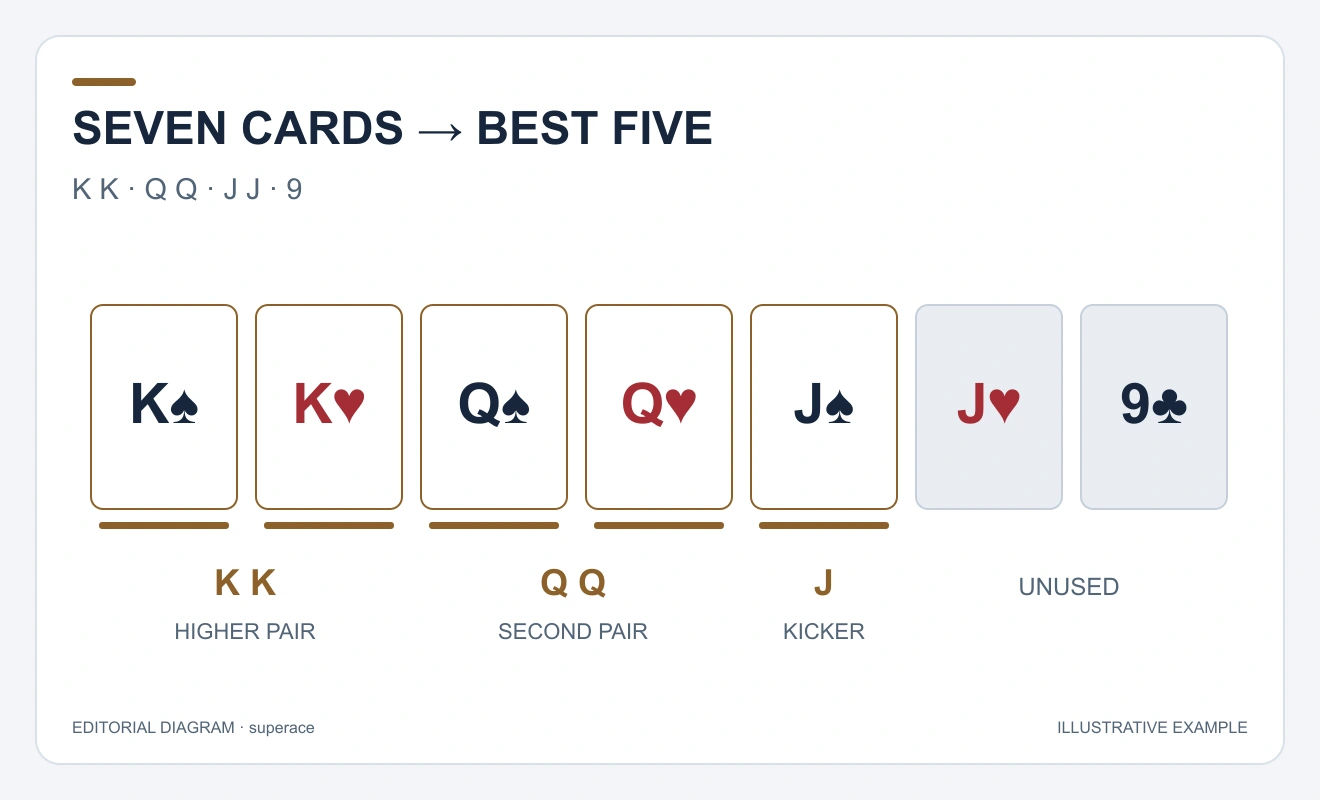
A Queen kicker cannot rescue the second candidate: compare the higher pair, then the lower pair, then the kicker. The PokerStars hand-comparison reference explains this order. The cards and worksheet here were chosen for this article.
What happens to the third pair?
Only one Jack fits after Kings and Queens occupy four places. The other Jack is unused. Calling both Jacks a third pair would require six cards, exceeding the five-card hand.
Keep the variant’s card-use rule with the record. A game requiring an exact number of private and community cards can restrict which subsets are legal. This example assumes any five of seven; it does not cover those restricted variants, side pots or prize amounts.
Use a three-step comparison key
- Choose the highest available pair. In this example it is Kings. A hand beginning with Queens and Jacks loses to a legal hand containing Kings, regardless of its kicker.
- Choose the highest remaining pair. Queens outrank Jacks. This comparison happens before the fifth card is examined.
- Fill the fifth position with the highest unused card. After both pairs are selected, a Jack is the highest remaining rank.
Writing the result as “Kings / Queens / Jack” helps prevent a visually prominent kicker from being compared too early. Suits identify the physical cards in the illustration; they do not break this standard high-hand tie.
What if there is an Ace outside the pairs?
Change the seven-card example to K♠ K♥ Q♠ Q♥ J♠ J♥ A♣. The two pairs remain Kings and Queens, but the Ace now becomes the kicker. The unused Jacks do not count as a third pair and do not outweigh the higher fifth card. This is a different seven-card set, so keep the two examples separate.
Check the permitted card combinations first
The worksheet assumes any five of seven available cards may be selected. That assumption is useful for standard seven-card evaluation, but it cannot be carried into a variant with mandatory private/community-card usage. If a game requires exactly two private cards, first eliminate any five-card candidate that breaks that requirement, then compare the legal candidates.
If two players finish with the same pair ranks and the same kicker rank, the comparison is tied under the standard high-hand rule. This does not determine who receives every chip in a real hand: eligible pots, contributions and the table’s settlement rules must also be known.