
Texas Hold’em ties: compare the best five, not unused hole cards
Different hole cards do not always produce different final poker hands. In standard Texas Hold’em, each player makes the best five-card hand from the five shared board cards and their two private cards. A private card left outside those five cannot break an otherwise equal comparison.
This worked example extends the poker explanations in the superace guide collection. The deals are invented, with a normal 52-card deck, ordinary high-hand rankings and no Wilds. They show a completed board, not predictions about cards still to come.
Using no hole cards can be correct
PokerStars’ Texas Hold’em rules allow a best five-card hand to use zero, one or two hole cards. That permission matters when the shared board is already better than anything either player’s private cards can create.
Consider this fictional completed deal:
| Cards | Holding |
|---|---|
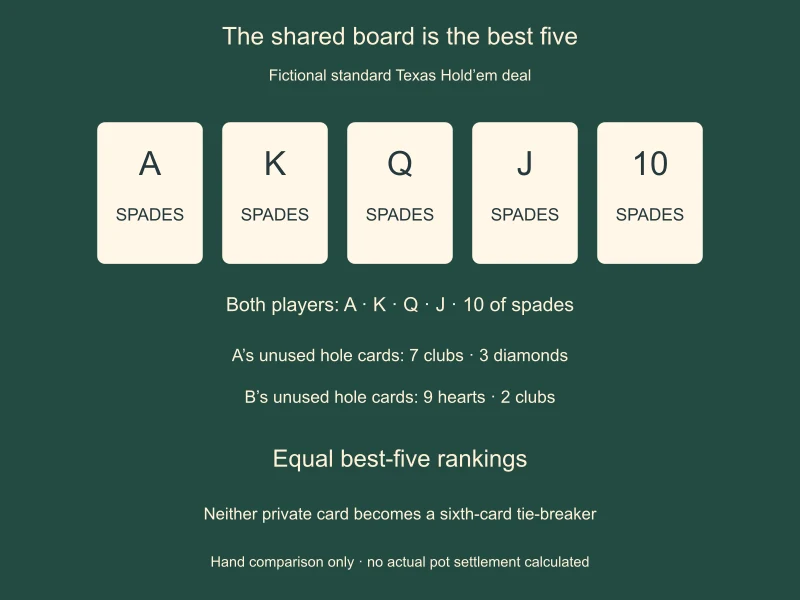
| Shared board | A♠ K♠ Q♠ J♠ 10♠ |
| Player A’s hole cards | 7♣ 3♦ |
| Player B’s hole cards | 9♥ 2♣ |
The board itself is an Ace-high straight flush, commonly called a royal flush. Both players’ best five are exactly A♠ K♠ Q♠ J♠ 10♠. Neither needs a hole card. Player B’s private nine does not beat Player A’s private seven because neither card is in the evaluated hand.
The tie does not create a sixth-card comparison
The five cards already determine the hand category and its rank. Comparing an unused sixth or seventh card invents a different rule. Likewise, the number of red hole cards, a private card’s suit or who showed first does not improve either five-card hand.
For this particular board, each player’s seven available cards produce 21 possible five-card selections. Checking them identifies the same highest selection: the five board cards. That enumeration is a check on a completed fictional deal; 21 selections are not 21 independent chances or a winning probability.
Equal hands can also use different physical cards
Now use a separate fictional board: 2♠ 2♥ K♣ 9♦ 4♠. Player A has A♣ 7♥, and Player B has A♥ 6♣. Both best-five rankings are a pair of twos with Ace, King and Nine kickers.
| Player | Best five | Unused cards | Comparison key |
|---|---|---|---|
| A | 2♠ 2♥ A♣ K♣ 9♦ | 7♥, 4♠ | (pair 2; A, K, 9) |
| B | 2♠ 2♥ A♥ K♣ 9♦ | 6♣, 4♠ | (pair 2; A, K, 9) |
The Aces are different physical cards, but their ranks are equal. Standard high-hand comparison does not rank the club Ace above or below the heart Ace. The unused seven cannot outrank the unused six because both are excluded from the best five. This is an equal ranking even though the two five-card selections are not physically identical.
The existing one-pair kicker guide explains the ordered comparison. Here the pair and all three relevant kickers tie. There is no fourth kicker to rescue either hand.
A hole card that enters the best five can matter
Keep that pair-of-twos board, but change the private cards to A♣ Q♥ for Player A and A♥ J♣ for Player B. The best-five keys become (pair 2; A, K, Q) and (pair 2; A, K, J). Now the third kicker differs, and Player A ranks higher because Queen outranks Jack.
The difference from the earlier deal is precise: Queen and Jack enter the legal best five by replacing the board’s Nine. In the earlier deal, Seven and Six could not replace the stronger Nine. A high-looking private card matters only through the best hand it actually makes.
For a full house, the comparison structure is different again. Read the triple-before-pair explanation rather than attaching a spare-card kicker to a five-card full house.
Hand ranking is separate from the amount paid
The examples establish equal or unequal high-hand rankings. Actual pot distribution additionally depends on who remains eligible for each pot and the relevant game procedure. A player who is not eligible for a side pot does not acquire a share of it merely by showing the same rank.
No bet sizes, side pots, rake or payout amounts are specified here, so this guide does not calculate a settlement. Keep the complete board, private cards, variant and eligibility information with any real hand record.
Do not transfer the “any five of seven” rule to every card-themed game or to ordered slot symbols. This article is about standard Texas Hold’em. Confirm the exact variant before evaluating available cards.
The three invented deals were checked by enumerating each player’s 21 five-card selections on 10 October 2026. The source supplies the Hold’em selection rule; the deals and comparison worksheet are original. No real hand, betting action or account transaction was played for this article.