
Poker kickers: the highest spare card does not settle every tie
When two standard five-card poker hands have the same pair, compare the remaining cards from highest to lowest. If the first kicker ties, move to the second. A matching Ace does not make the whole hand a tie.
For the topic overview, see Detailed guides.
The order matters: pair first, then the three kickers. This guide uses ordinary high-hand poker without wild cards or special low-hand rankings.
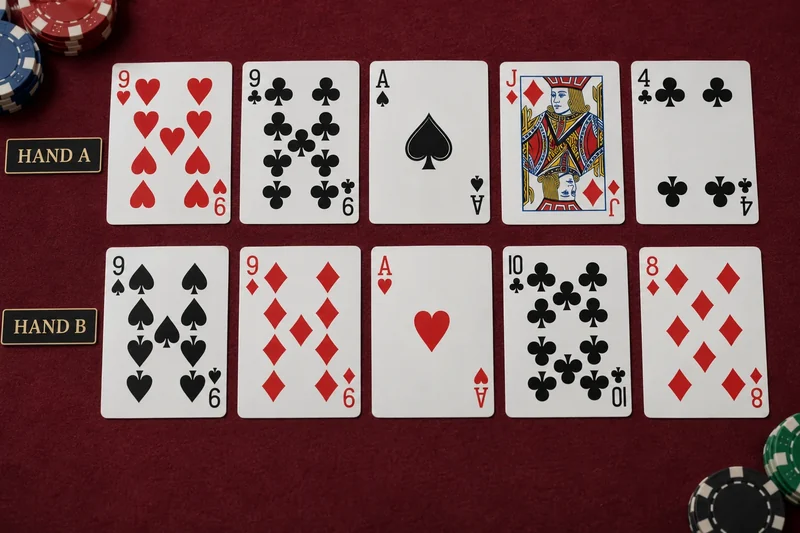
Build a comparison key from five cards
Bicycle’s poker rules describe equal-pair comparisons using the next ranked card. For one-pair hands, write the pair rank followed by the other three ranks in descending order. Suits do not become an extra tie-breaker in this standard comparison.
For 9♣, 9♦, A♠, J♥, 4♣, the key is (9; A, J, 4). Keep all five cards in the hand, but compare the pair as a group before the kickers.
Find the first difference
| Invented hand | Comparison key | What decides it |
|---|---|---|
| 9♣ 9♦ A♠ J♥ 4♣ | (9; A, J, 4) | Jack second kicker |
| 9♥ 9♠ A♦ 10♣ 8♦ | (9; A, 10, 8) | Ten second kicker |
The pair ranks tie at nine. The highest kickers tie at Ace. The next comparison is Jack against Ten, so the first hand ranks higher. The 8 in the second hand never gets a chance to overcome the 4: the comparison has already been decided at the previous position.
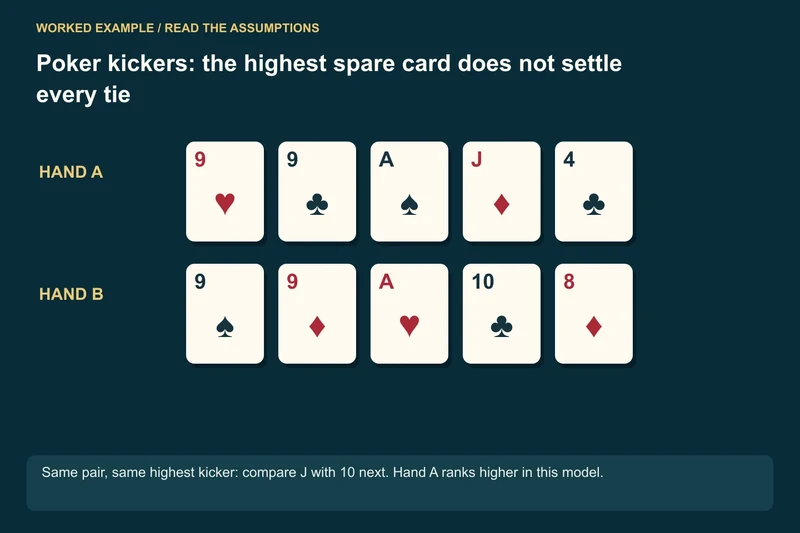
Why adding the card values gives the wrong test
A kicker comparison is ordered, not a sum. Adding numerical values or counting the number of red cards invents another ranking system. The same is true of jumping straight to the lowest remaining card because it shows the largest visible difference.
Now compare (9; A, J, 4) with (9; A, J, 3). The pair and first two kickers tie, so the last kicker matters this time. This does not contradict the earlier example; it follows the same first-difference rule.
More available cards still require a legal five-card hand
In a game that presents more than five cards, identify each player’s legal best five under that variant before making this comparison. A sixth card outside those five is not an extra kicker. In a community-card game, both players may end with the same five-card ranking.
Equal rankings are only one part of pot settlement. Eligibility and side pots can require separate checks. The worked example explains hand order, not who is entitled to every chip in an actual game. Preserve the five cards and variant with any disputed result.
The superace homepage brings together the site’s other reading topics.
Source-based editorial research and original examples. Sources checked 9 October 2026. No real-money play or account transaction was performed for this article.
Related reading
Texas Hold’em ties: compare the best five, not unused hole cards | superace